
The Wartegg Test is a curious and widely used psychological tool that invites us to complete a series of drawings based on simple visual stimuli. Through this process, we can uncover hidden aspects of our personality, our emotions, and how we interact with the world.
In this article, we will break down the core aspects of the Wartegg Test, exploring its history, how it works, and how it is interpreted. Discover the secrets that your drawings and those of your patients have to tell.
Wartegg Test PDF
Download the Wartegg Test in PDF format at the following link, completely free of charge.
What is the Wartegg Test?
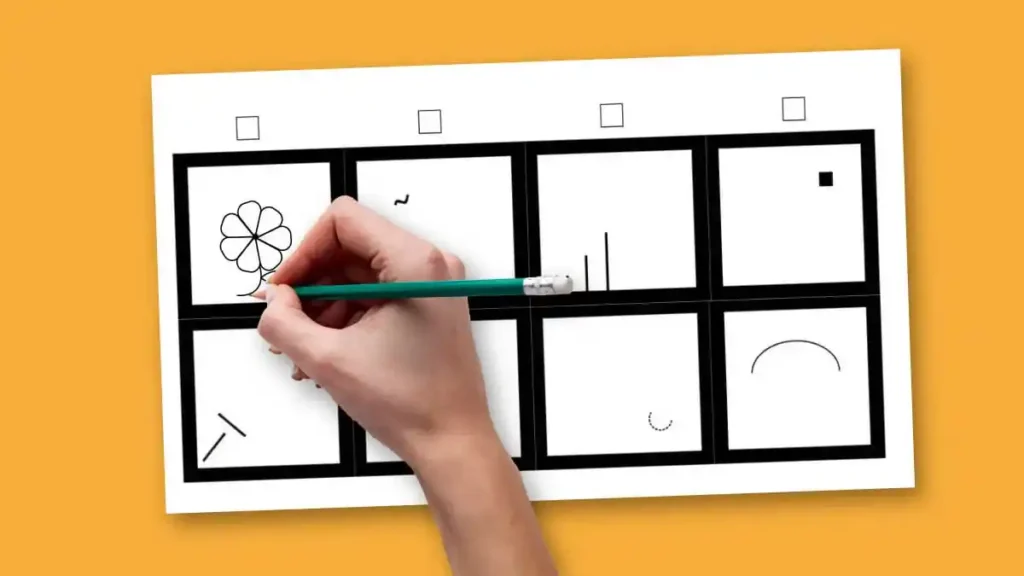
The Wartegg Test, also known as the “8-Box Test,” is a graphic projective technique designed to explore an individual’s personality and cognitive processes. Unlike objective tests, which rely on predetermined answers, the Wartegg Test invites the subject to express their inner world through drawing.
According to researchers (2011), “The Wartegg-Zeichentest (WZT) is considered a graphic projective test that yields valuable information regarding personality structure and dynamics.”
How Does the Wartegg Test Work?
The test consists of eight squares, each containing a different visual stimulus (a line, a dot, a curve, etc.). The subject is asked to complete each square with a drawing. The way the person approaches each stimulus, the themes they choose, and how they organize the squares as a whole provide valuable insights into their personality, emotions, and cognitive style.
Comparison with Other Projective Tests
Compared to the famous Rorschach Test, which uses ambiguous inkblots to elicit responses, the Wartegg Test offers more structured visual stimuli. This difference makes it easier to administer and often leads to less ambiguous interpretation. However, both tests share the goal of exploring personality through the projection of unconscious content.
Historical Context: Who Created it and Why?
The test was created by Ehrig Wartegg, a German psychologist, in the early 20th century. Wartegg developed this tool to provide a quick and efficient way to analyze personality. His approach was based on the idea that simple visual stimuli can trigger significant responses from the unconscious, revealing hidden layers of the human psyche.
As González (2024) notes, “After years of research, he designed this test to be a fast and effective tool for personality analysis. The Wartegg test is based on the idea that we project relevant aspects of our personality onto the images we create from simple stimuli.”
The Wartegg Test has been widely used in various fields, from clinical psychology to personnel selection, due to its ability to provide valuable personality data in a relatively simple and fast manner.
How is the Wartegg Test Administered?
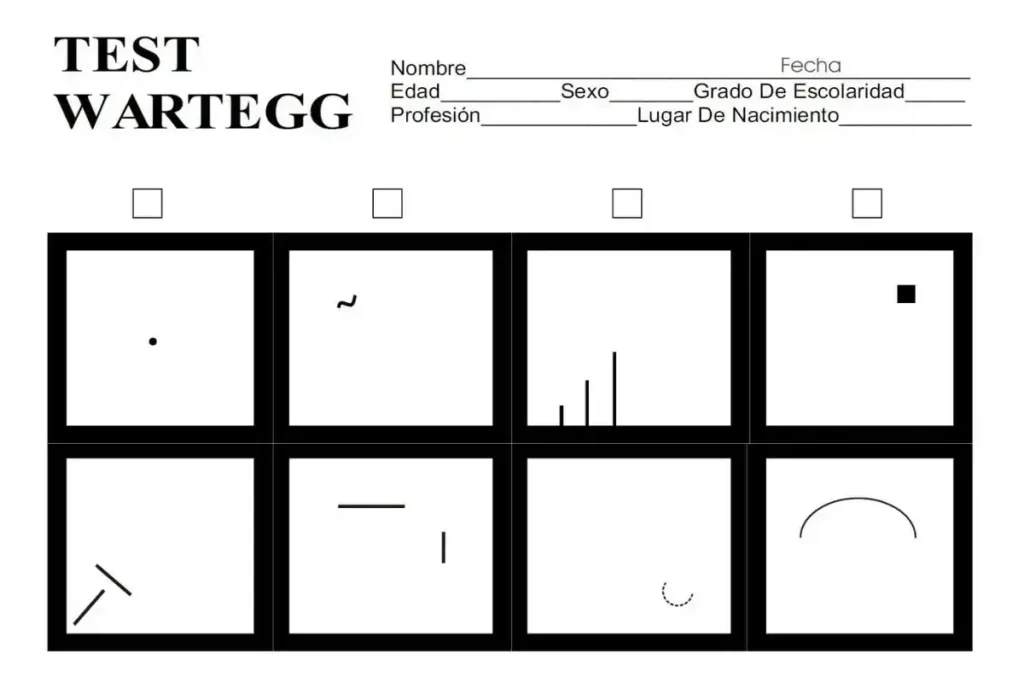
This test is typically administered individually. The format consists of a sheet of paper divided into eight squares, each with a different predefined stroke. These strokes dots, lines, curves, or angles serve as the initial stimulus for the subject to start drawing.
Step-by-Step Completion
If you are going to administer this test, here are the recommended steps to ensure the subject understands the task. It is important that the participant is in a quiet, comfortable environment for the best results.
Material Presentation
Hand over the printed test sheet and instruct them to complete each square with a drawing, using the predefined stroke as a starting point. Emphasize that there are no “good” or “bad” drawings; the focus is on following the instructions correctly.
Drawing Phase
The subject completes each square individually, drawing whatever the visual stimulus suggests to them. There are no restrictions on theme or style.
Order and Numbering
While it is suggested to complete the squares in numerical order, if they choose to change the sequence, they must number the boxes according to the order in which they were drawn.
Titling
After finishing all the drawings, the subject is asked to give each one a title.
Preferences
Once complete, the subject identifies which drawing they liked the most and which one they liked the least.
Difficulty Level
Finally, the subject indicates which drawing was the easiest to complete and which was the most difficult.
Estimated Duration and Use Cases
The test usually takes about 20 to 30 minutes, though this can vary. It is applied in several contexts:
- Clinical Psychology: To evaluate patients’ personalities, emotions, and cognitive processes.
- Personnel Selection: To assess personality traits and candidate potential. As Vitae Educación Ejecutiva (2021) states, “The Wartegg test is a tool used in recruitment to represent vital situations that the candidate must resolve.”
- Vocational Guidance: To help individuals discover their interests and aptitudes.
What Does the Wartegg Test Analyze?
The Wartegg Test analyzes various aspects of personality and psychological functioning. Through the drawings, it is possible to obtain data on emotions, moods, internal conflicts, creativity, problem-solving skills, defense mechanisms, and the individual’s relationship with their environment.
According to Handler & Thomas (2013), “The Wartegg test is a projective technique that can provide valuable information about an individual’s personality, emotional functioning, and cognitive style.”
Common Interpretations (Examples)
- Box 1 (The Dot): A direct reflection of self-image. The size and prominence of the drawing reveal the need for self-assertion or the presence of healthy self-esteem. Tiny strokes may indicate insecurity.
- Box 2 (Curved Lines): Explores interpersonal dynamics. Faces often denote a social orientation, while nature scenes might suggest a preference for relationships based on trust.
- Box 3 (Three Straight Lines): Unveils aspirations and goals. Ascending, structured lines reflect meticulous planning and achievement orientation.
- Box 4 (Small Square): Often left for last, this box delves into the unconscious. Heavy shading or excessive use of black may signal unresolved internal conflicts or depressive tendencies.
- Box 5 (Diagonal Lines): Evaluates vitality and energy. Joining the stimuli and pointing them toward the right indicates dynamism and a forward-looking attitude.
- Box 6 (Parallel Lines): Reveals cognitive style. Creating two related but distinct drawings shows an ability for association and synthesis.
- Box 7 (Dotted Lines): Explores workplace interpersonal dynamics and sensitivity. Respecting the original stimulus denotes a collaborative attitude.
- Box 8 (Curve/Arc): Evaluates adaptation to norms and authority. A drawing placed below the stimulus may suggest submission, while one above it could indicate a tendency to question authority.
Pros and Cons of the Wartegg Test
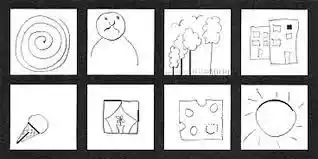
The test stands out for its practicality and efficiency. It is easy to apply, requires no complex materials, and provides a wealth of information in a short time.
Criticisms
Despite its advantages, the Wartegg Test has faced criticism regarding its validity and reliability:
- Subjectivity: Interpretation can be subjective, posing challenges for objectivity and consistency.
- Standardization: A lack of global standardized norms makes it difficult to compare results across different studies.
- Cultural Bias: As Mateu-Mollá (2019) mentions, “Because the Wartegg test was developed in a specific cultural context… interpretation could be influenced by cultural and educational factors that the test does not account for.”
Is the Wartegg Test Still Useful Today?
Despite the rise of new assessment tools, the Wartegg Test remains in use. Many experts believe that when combined with other techniques, it provides a meaningful “snapshot” of the human psyche. As Handler and Thomas (2013) note, while some question its validity, others find it a useful tool for evaluating personality and cognitive functioning.
What do you think of the Wartegg Test? Have you ever taken a projective test like this? Share your thoughts in the comments!
References
- González, C. (2024). Wartegg Test: What it is, how it’s evaluated, and… is it really reliable? Global Human Consultants.
- Handler, L., & Thomas, A. D. (Eds.). (2013). Drawings in Assessment and Psychotherapy: Research and Application. Routledge.
- Mateu-Mollá, J. (2019). Wartegg Test: What it is and how this projective test is used. Psicología y Mente.