
The preschool years are a whirlwind of discovery and high energy. It’s natural for parents and educators to wonder if they are providing the right tools for optimal brain development and a smooth transition to kindergarten. Fortunately, the solution doesn’t require expensive educational kits or complex curricula. The answer lies in play the most natural, effective, and usually zero-cost educational strategy available.
Play is far more than just a pastime; it is the fundamental mechanism through which children build logic, learn to manage frustration, negotiate, and solve problems. It is the literal foundation of critical thinking. To help you harness this power, we’ve created this comprehensive guide. Inside, you’ll find a catalog of over 50 activities organized by age and skill set, designed to give you the confidence and simple tools to ensure meaningful early childhood learning happens right at home.
Quick Reference: The Top 5 Zero-Cost Activities
To get started immediately, here are five high-impact activities using everyday household items:
- Logic: Color Sorting (Ages 3–4), using blocks, bottle caps, or socks.
- Fine Motor: The Clothespin Challenge (Ages 3–5), using standard clothespins.
- Gross Motor: Indoor Obstacle Course (Ages 4–5), with pillows, chairs, and cushions.
- Sensory: The Rice Station (Ages 3–4), using dry rice, cups, and spoons.
- Socio-Emotional: Symbolic Roleplay (Ages 3–5), using dress-up clothes or old outfits.
Pedagogical Foundations: Why Play is Essential
In preschool, children aren’t just “taking lessons” they are building their brains. Every activity is a brick in the structure of their future learning. The secret to being a great educator (or parent) is understanding which “brick” each game develops.
What Should a Preschooler Be Learning? The 4 Key Areas
Early education focuses on holistic development, ensuring no skill is left behind:
Cognitive Development
The engine of logical thinking. This includes number sense (counting), problem-solving (“How do I keep my tower from falling?”), and classification (the basics of math and science).
Language Development
Beyond just words. This involves phonological awareness (identifying sounds within words) and descriptive language to express complex thoughts and emotions.
Motor Development (Fine & Gross)
The mind-body connection. Without strong fine motor skills, writing becomes a struggle. Without proper gross motor skills, balance and athletic coordination are difficult to master.
Socio-Emotional Development
The most important skill for life success. This is where children learn to share, wait their turn, manage frustration, and develop empathy (understanding how others feel).
The Exhaustive Catalog: Activities by Skill and Age
Below is an expanded catalog of over 50 activities designed for low cost and high impact.
Fine Motor Skills: Pre-Writing Games
Fine motor skills refer to the small movements of the hands, wrists, and fingers. These are key for future pencil grip, using utensils, and buttoning clothes. These activities strengthen the crucial “tripod grip” (thumb, index, and middle fingers).
Creative Threading (Ages 3–4)
Focuses on the tripod grip and hand-eye coordination. Use household items like large tube pasta, wooden beads, or cut-up plastic straws to thread onto a thick string or shoelace.
Flour Tracing (Ages 3–5)
Spread a thin layer of flour, cornmeal, or salt on a baking sheet. Encourage the child to use their index finger to draw scribbles, circles, or straight lines. This provides immediate sensory feedback without the pressure of a pencil.
The Clothespin Challenge (Ages 3–5)
Essential for building hand strength. Have the child clip clothespins onto the edge of a cardboard box or a paper plate. You can add a math component by having them count the pins as they go.
Paper Tearing and Gluing (Age 3)
Tearing paper is a natural way to develop bilateral coordination (using both hands together). Let them tear old magazines or wrapping paper into small bits and glue them inside a simple shape, like an apple or a circle.
Homemade Playdough Modeling (Ages 4–5)
Kneading, rolling, and pinching dough exercises every muscle in the hand. Add a challenge by having them “cut” the dough with safety scissors or roll tiny balls using only their fingertips.
Dropper or Syringe Transfers (Ages 4–5)
A Montessori classic. Use a medicine dropper or a needleless syringe to move colored water from one cup to an ice cube tray. This requires immense concentration and squeeze-pressure control.
The Lid and Screw Box (Ages 4–5)
Twisting and untwisting bottle caps or nuts and bolts is excellent for bilateral coordination and digital dexterity. It’s the perfect precursor to opening jars or containers.
Cutting Lines and Shapes (Age 5)
Once they master tearing, move to safety scissors. Start with thick, straight lines on cardstock, gradually progressing to zig-zags, curves, and eventually geometric shapes.
Toothpicks in a Colander (Ages 3–4)
A low-cost exercise for “fine-tuning” aim. Have the child insert toothpicks or straws into the holes of an upside-down kitchen colander.
Buttons and Zippers (Age 5)
Create a “dressing board” with old scraps of fabric featuring buttons and zippers. This builds the advanced fine motor skills needed for daily independence.
Math Logic and Pre-Numeracy
Logical thinking is the root of intelligence. In preschool, this translates to classifying, comparing, ordering, and counting.
Attribute Sorting (Ages 3–4)
Group objects (blocks, buttons, socks) by one or more attributes like color, shape, or size. This teaches the child to create mental “rules.”
Sequencing and Patterns (Ages 4–5)
Use blocks or colored cards to create a pattern (Red-Blue-Red-Blue) and ask the child to continue it. This trains predictive logic and working memory.
The Home “Grocery Store” (Age 5)
A fun way to practice counting and basic addition. Use beans or play money to “buy” household items, reinforcing one-to-one correspondence.
Size Seriation (Ages 4–5)
Ask the child to arrange 5 or 6 objects (sticks, stones, toys) from smallest to largest. This teaches the concept of logical order and comparison.
One-to-One Correspondence (Ages 3–4)
Draw five circles on a paper and give the child five beans. Ask them to place exactly one bean in each circle. This is the pillar of true counting.
Simple Toy Graphs (Age 5)
Line up two different collections (e.g., toy cars vs. stuffed animals) in parallel rows. Ask, “Which row is longer?” or “Which has more?” to introduce basic data visualization.
Homemade Cardboard Puzzles (Age 4)
Glue a magazine picture onto cardboard and cut it into 4–6 large pieces. Reconstructing the “whole” from “parts” develops spatial perception.
The Hidden Treasure (Spatial Concepts) (Ages 4–5)
Hide a toy and give verbal directions using “behind,” “under,” “to the left,” or “above.” This builds the vocabulary needed for geometry.
Themed Countdowns (Ages 3–5)
Use “3-2-1 Blastoff!” for toy rocket launches or races. It helps children internalize the number sequence and understand decreasing quantities.
Shape Safari (Ages 4–5)
Go on a walk around the house to find “real-life” shapes (e.g., “The plate is a circle,” “The door is a rectangle”). This connects abstract math to the physical world.
Gross Motor and Balance (10+ Activities)
Sometimes, the best educational activity is the one that lets a child burn off the energy that’s distracting them. These develop balance, coordination, and spatial awareness.
Pillow Obstacle Course (Ages 4–5)
Use cushions, chairs, and blankets to create a path. Crawling under, jumping over, and balancing through it builds motor planning.
The Animal Train (Ages 3–4)
Have the child imitate animal movements (hop like a frog, slither like a snake, waddle like a duck). This improves flexibility and coordination.
Musical Statues (Ages 3–5)
Play music and dance; when the music stops, everyone must freeze. This builds “inhibitory control,” a key skill for classroom behavior.
The Floor is Lava (Ages 4–5)
Use pillows or rugs as “safe islands.” Jumping from one to another improves dynamic balance and spatial planning.
Tape Line Walk (Ages 4–5)
Place masking tape on the floor in straight or zigzag lines. Have the child walk heel-to-toe like a tightrope walker to improve posture and core stability.
Sock Toss (Ages 3–5)
Use a laundry basket as a hoop and rolled-up socks as balls. This builds hand-eye coordination and depth perception.
Scarf Dancing (Ages 3–5)
Use light scarves or fabric strips to dance to different tempos of music. This encourages creative expression and gross motor fluidity.
“Land, Sea, Air” (Age 5)
A reaction game. Assign an action to each (e.g., Land = stand still, Sea = sit, Air = jump). Call them out quickly to build processing speed.
Heavy Lifting (Ages 4–5)
Ask the child to help “transport” a stack of books or a box of toys using their back or head (safely). This builds trunk stability and proprioception.
The Mirror Game (Ages 4–5)
Stand face-to-face; one person moves slowly, and the other must mimic them exactly. This builds interpersonal connection and body awareness.
Sensory Play and Exploration
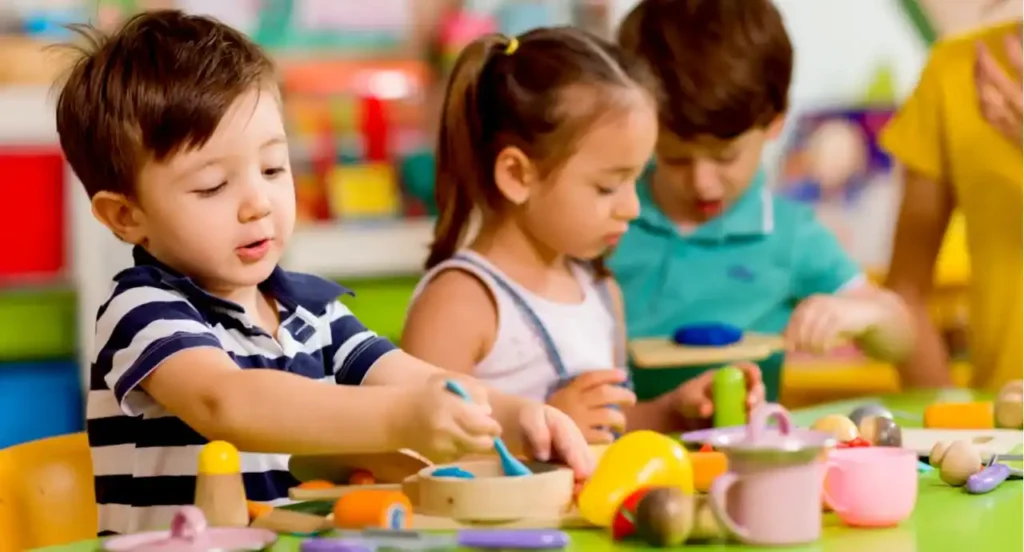
Sensory play stimulates the five senses and is vital for self-regulation and focus. These are perfect for “calming down” periods.
The Rice or Water Station (Ages 3–4)
A large bin filled with dry rice or water, plus cups and funnels. This promotes calm, concentration, and fine motor precision.
The Mystery Texture Box (Ages 3–5)
Place objects with different textures (rough, smooth, soft) in a box. Have the child feel them without looking and describe what they feel.
Sponge Painting (Ages 3–5)
Use sponges or old toothbrushes instead of brushes. The unusual textures and sensations encourage exploration over “perfect” results.
Calm Down Bottles (Ages 3–5)
Fill a clear bottle with water, glitter, and a little clear glue. Shaking it and watching the glitter settle is a fantastic visual tool for emotional regulation.
Buried Treasure (Ages 4–5)
Hide plastic letters or toys inside a bin of sand or beans. Digging for them provides rich sensory input and improves finger aim.
Texture Walk (Ages 3–5)
Place different materials on the floor (towel, sandpaper, bubble wrap). Have the child walk across them barefoot and describe the sensations.
“What’s That Smell?” (Ages 4–5)
Use jars with common scents (cinnamon, coffee, vanilla). This builds olfactory recognition and descriptive vocabulary.
Improvised Light Table (Ages 4–5)
Place a flashlight under a clear plastic bin or use translucent objects on a window. It magnifies the visual experience of shapes and colors.
Ice Painting (Ages 4–5)
Freeze colored water into ice cubes with popsicle sticks. Painting with the melting ice is a fascinating way to learn about states of matter.
Mud Kitchen (Ages 3–5)
The ultimate sensory experience. Let them mix dirt and water to mold “mud pies.” It is deeply calming and stimulates natural creativity.
Language and Phonological Awareness
Phonological awareness (identifying sounds in words) is the strongest predictor of future reading success. It’s not about the ABCs; it’s about playing with sound.
Rhyme Time (Ages 4–5)
Say a word (e.g., “Cat”) and have the child say a rhyming word (“Hat”). This builds auditory memory and verbal rhythm.
Active Reading (Ages 3–5)
Stop during a story and ask, “How do you think the character feels?” or “What happens next?” This promotes comprehension and descriptive language.
“I Spy” with Sounds (Ages 4–5)
Instead of colors, say “I spy with my little eye something that starts with the /B/ sound.” This helps them isolate starting sounds.
Syllable Clapping (Ages 4–5)
Say a word like “Ap-ple” and clap out the syllables. This auditory segmentation is the foundation for reading and writing.
Inventing Story Endings (Age 5)
Read a story up to the climax and let the child invent the ending. This encourages verbal fluency and narrative structure.
Shadow Puppets (Ages 4–5)
Use a flashlight and a wall to tell stories. This develops oral expression and diction as they “perform” for their audience.
Telephone (Ages 4–5)
Whisper a message from person to person. It’s a fun way to practice active listening and sequential auditory memory.
Description Without Naming (Age 5)
Describe an object (e.g., “It’s big, has four legs, and we sit on it to eat”) and have the child guess what it is. This builds inference skills.
Inventing Songs (Ages 3–5)
Take a familiar tune (like “Twinkle Twinkle”) and change the lyrics to describe their day or their feelings. This promotes word awareness and rhythm.
The “Daily News” Poster (Age 5)
Have the child draw what they did today and “write” the story (even if it’s just scribbles or random letters). It teaches that writing represents spoken language.
Socio-Emotional Development: Empathy and Clear Rules
Life has rules, and frustration is inevitable. The goal is to teach resilience.
Simple Rule Games
Play games with winners and losers (Musical Chairs, Candy Land). If they lose, don’t say “It’s fine.” Instead, validate them: “I see you’re frustrated because it’s not your turn. It’s okay to feel that way. Take a breath, and you’ll start again in a minute.”
The Emotion Mirror
Use cards with faces showing different emotions. Have the child mimic them and ask, “When do you feel like this?” This gives them the vocabulary to express their inner world.
The Leap to Elementary School: Activities for Ages 5–6
The transition to Kindergarten or 1st Grade can be stressful.
- Practicing Self-Regulation: School requires sitting and waiting. Practice “Scheduled Stillness” by having them look at a book quietly for 5 minutes, gradually increasing the time.
- School Routine Simulation: Play “going to school.” Pack a backpack, wait for a “bell,” and sit at a table for a “task.” Familiarity reduces anxiety.
- Name Recognition: Ensure the child can not only recognize their name but also attempt to write it. Their name is their first “success word.”
Methodological Guide: The Educator’s Playbook How to Plan Your Play Week
Planning doesn’t have to be rigid; it should be a framework that provides structure.
- The 30-Minute Rule: Don’t stretch an activity past a child’s attention span. For a preschooler, 20–30 minutes of intense, directed play is plenty.
- Balanced Schedule: Rotate between active play and quiet focus.
- Monday: Fine Motor/Language focus.
- Wednesday: Gross Motor/Logic focus.
- Friday: Sensory/Free Exploration focus.
Responsible Tech Use
Screens cannot replace the brain plasticity gained from touching textures or threading a string. Use technology for music or specific tutorials, never for “free play” alone.
Frequently Asked Questions
Is it safe to use rice or beans for sensory play with a 3-year-old?
Yes, it is safe, but always under strict adult supervision. Ensure the child does not have a tendency to put small objects in their mouth. If they do, substitute rice with large noodles or giant-shaped pasta.
What should I do if my child gets frustrated and throws the activity (like threading)?
Frustration is often a sign that the activity is too difficult. Reduce the difficulty immediately: use thicker laces, much larger beads, or simplify the goal to just “touching the beads.” Validate the feeling, but not the act of throwing.
How can I use a Rice Station (Sensory) to teach Math Logic?
Incorporate “measuring” into the play. Ask, “How many scoops do you need to fill the small cup?” You can also use a funnel to sort: put large beans and small rice together and ask them to separate just the beans into a different container.
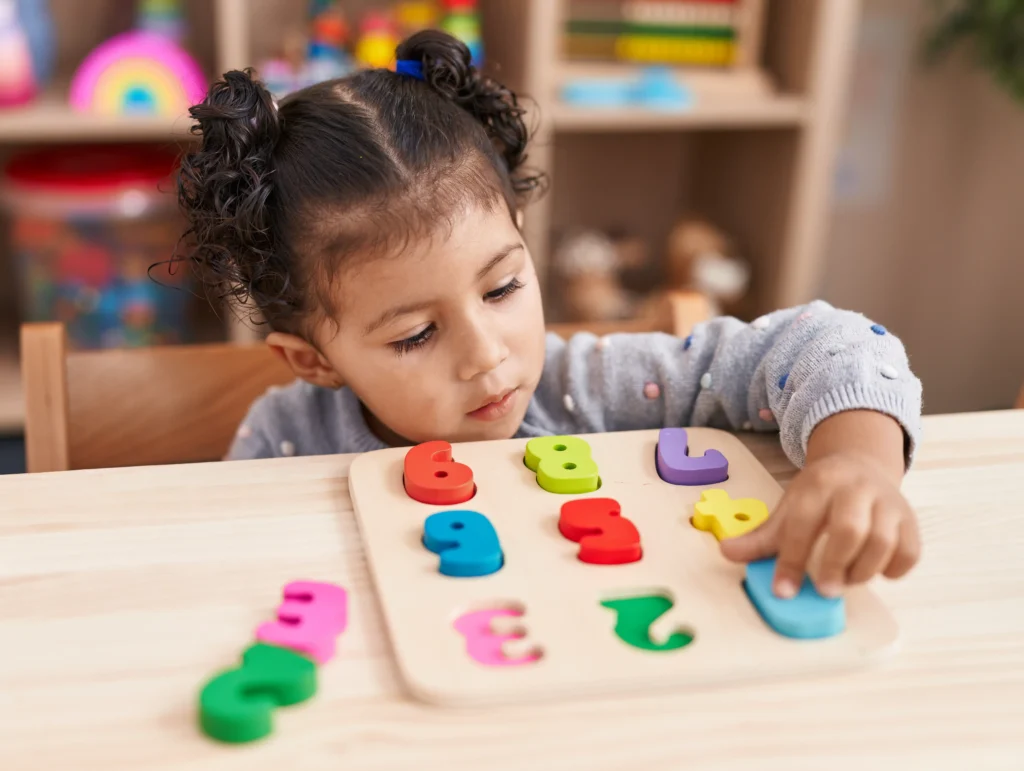
What kind of homemade puzzle is best for the transition to Kindergarten (Ages 5–6)?
Puzzles that contain numbers or letters. For example, write a number sequence or the alphabet on cardboard and then cut the pieces. This combines spatial skills with sequence memorization.
Does my child need to know the alphabet before starting Elementary school?
It is not strictly necessary, but it is vital they develop Phonological Awareness (knowing that a word can be broken into syllables or identifying starting sounds). This is far more important than memorizing letter names.
My child won’t walk on the straight line. How can I make balance exercises more engaging?
Turn it into symbolic play. Say the line is a “bridge over a dangerous river” or the edge of an “enchanted castle.” Use bright-colored tape or a real rope to make it more visual.
At what age is it ideal to start practicing with safety scissors?
Generally around 3–4 years old, as soon as they show interest and have enough grip strength. Start with safety scissors that only cut paper (not fabric) and allow them to cut simple straight lines or paper strips under constant supervision.
What is the difference between Symbolic Roleplay and Free Play?
Symbolic Roleplay (playing doctor, chef, etc.) is a type of free play, but it stands out due to its social focus. It requires planning, negotiating roles, and using language to create a narrative. It is free play with an added social structure.
If my child uses a dropper in sensory play, are they working on fine or gross motor skills?
Primarily Fine Motor Skills. The action of squeezing and releasing the dropper bulb requires high precision and strength in the tripod grip (thumb, index, and middle fingers), the same grip used for holding a pencil.
Should I correct my child immediately if they make a mistake counting 10 objects?
No, avoid immediate correction. Instead, use the “re-counting” technique. You count the objects correctly yourself, then ask them to count with you, touching each object together. The initial goal is One-to-One Correspondence, not just memorizing a total number.
The preschool years fly by. The greatest gift we can offer our children isn’t early academic knowledge, but the confidence and curiosity born from play. By investing time in these activities, you aren’t just developing their logic or motor skills; you are building a relationship based on joy and discovery.
Every block stacked, every story read, and every frustration overcome during a game is a direct investment in their future academic and personal success.